
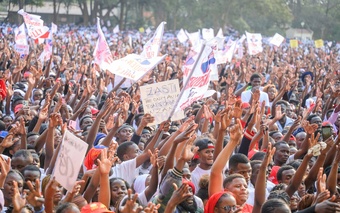
PC: Hakainde Hichilema/facebook
Zambia is heading into one of its most closely watched general elections in recent years, with voters preparing to go to the polls on Thursday, 13 August 2026. The election will determine not only who occupies State House for the next five years, but also the composition of Parliament and local government leadership across the country.
The
Electoral Commission of Zambia (ECZ) says voting will take place from 06:00 to 18:00, with
8,786,300 registered voters eligible to participate.
At
the centre of the contest is incumbent President Hakainde Hichilema, leader of
the United Party for National Development (UPND), who is seeking a second term
after his emphatic victory over former President Edgar Lungu in 2021. His
principal challenger is Brian Mundubile, a former opposition leader and
parliamentarian who is making his first bid for the presidency and has emerged
as the main rallying point for sections of Zambia's fragmented opposition.
Although several candidates are contesting the presidency, recent assessments
have increasingly characterised the race as being primarily between Hichilema and Mundubile.
For
Hichilema, the election is effectively a referendum on five years of economic management. When he took office in 2021, Zambia was struggling
with the consequences of its 2020 sovereign debt default. His administration
subsequently secured a restructuring of the country's external debt and has
sought to restore investor confidence, fiscal stability and relations with
international lenders. By June 2026, annual inflation had fallen to 6.5 per
cent, while the International Monetary Fund projected economic growth of about
4.3 per cent for 2026.
But
improved macroeconomic indicators do not necessarily translate into favourable
perceptions at household level. The cost of living, employment and
economic opportunity have become
major campaign issues, giving the opposition an opening to argue that Zambia's
economic recovery has yet to sufficiently improve everyday life. Mundubile has
sought to contrast stronger foreign reserves and improving national indicators
with the financial pressures still being experienced by ordinary families.
An
Election About Democracy Too
Economic
performance, however, is only one dimension of the 2026 contest. Zambia has
long been regarded as an important example of peaceful transfers of political
power in Africa, including the transition from Lungu to Hichilema following the 2021 election. Yet concerns about the
political environment have grown ahead of this year's vote.
Opposition
figures have accused the Hichilema administration of restricting political
activity and suppressing dissent, allegations that the president rejects. Civil
society organisations have also raised concerns about the Cyber Crimes Act introduced in 2025, arguing that some provisions could discourage free
expression online. Recent constitutional reforms expanding parliamentary
representation have similarly generated debate, with supporters presenting them
as measures to improve representation while critics have questioned their
timing and potential political implications.
Those
constitutional changes also mean that the 2026 election will be conducted under
a substantially altered parliamentary framework. The number of constituency-based
seats has increased from 156 to 226, following the creation of 70 additional
constituencies. Zambia has also introduced a mixed-member system incorporating
40 proportional-representation parliamentary seats intended to increase the
representation of women, young people and persons with disabilities.
The
Mathematics of State House
Winning
the presidency requires more than simply finishing ahead of the other
candidates. Under Zambia's electoral system, a presidential candidate must
obtain more than 50 per cent of valid votes cast. If nobody reaches that threshold
in the first round, the two leading candidates proceed to a second ballot,
which must be held within 37 days.
That
requirement makes opposition fragmentation especially significant. Hichilema
enters the election with the advantages of incumbency and improving headline
economic indicators, while Mundubile is attempting to consolidate voters
dissatisfied with the government's performance. A late-2025 survey cited by
Reuters put Hichilema comfortably ahead, but it was conducted before Mundubile
had fully emerged as the principal opposition challenger, making the closing
stages of the campaign particularly important.
More
Than a Presidential Contest
The
election will also shape Zambia's legislative and local political landscape.
Voters are choosing representatives for the National Assembly as well as local
government officials, meaning the eventual balance of power will determine how
effectively the next president can advance legislation and implement policy. The
ECZ has confirmed that parliamentary contests will take place across the
country's newly expanded 226 constituencies.
Ultimately,
the 13 August election will be a choice between competing assessments of
Zambia's direction. Hichilema is asking voters for another term to consolidate
an economic recovery that his government argues is beginning to bear fruit.
Mundubile and the wider opposition are asking whether those improvements have
reached ordinary households quickly enough and whether the country's democratic
institutions remain sufficiently open and competitive.
For
Zambia, therefore, Election 2026 is about much more than who wins State House.
It is a test of whether economic reforms can command popular support, whether
political competition can remain credible and peaceful, and whether one of
Southern Africa's most notable multiparty democracies can once again deliver an
electoral outcome accepted by its citizens. The answer will begin to emerge
when nearly 8.8 million registered voters are called to make their choice on 13
August.
 Take Voters' Compass